This blog was written by Alisha Ostberg and Edited by Oluwaseun Ayodeji Osowobi
Every September 30, Canadians mark the National Day for Truth and Reconciliation. For many, it appears as a holiday on the calendar. For survivors of the residential school system, the Sixties Scoop, and for generations of Indigenous families living with the legacy of colonialism, the day holds an entirely different weight.
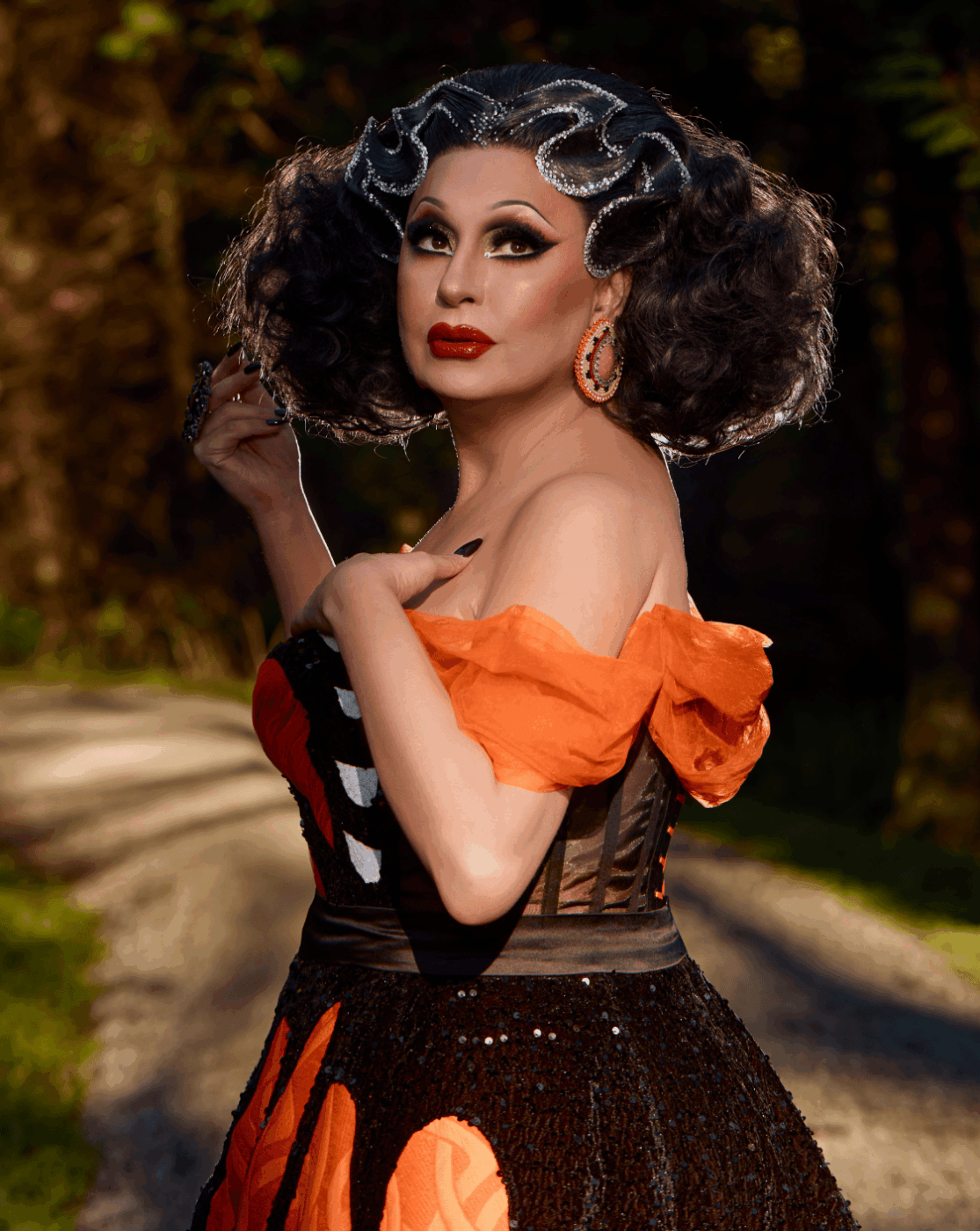
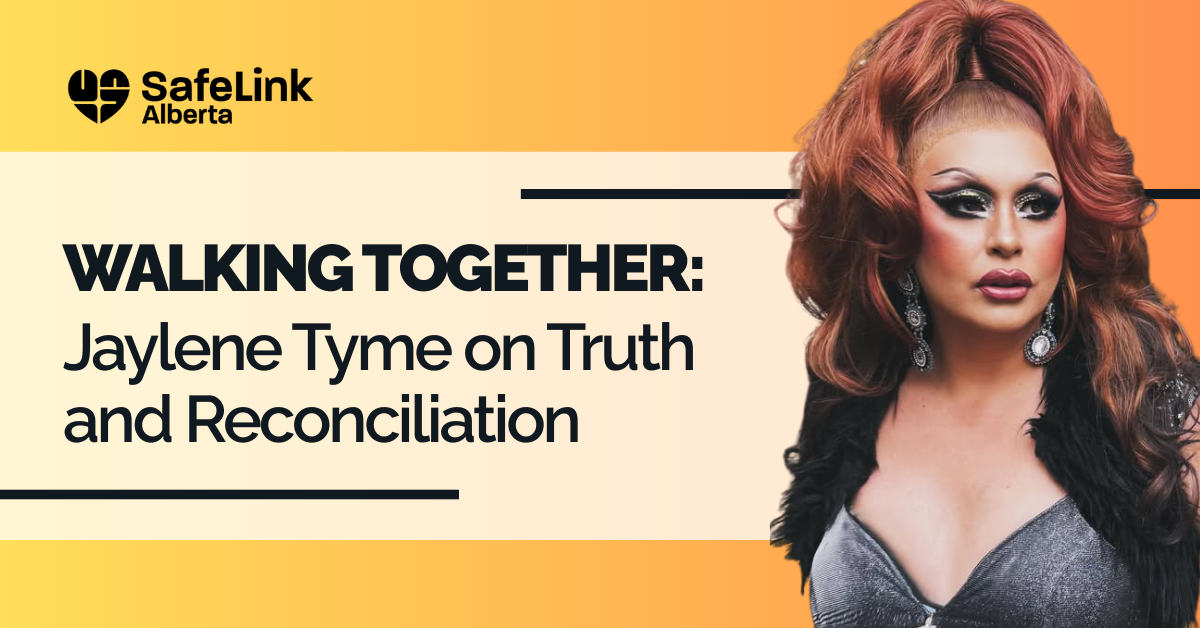
SafeLink Alberta spoke with Jaylene Tyme — a Two-Spirit, transgender Sixties Scoop survivor, drag artist, and community leader — about what this day means, how settlers can act with responsibility, and what hope she carries for the future.
About Jaylene Tyme:
Jaylene Tyme is a Two-Spirit, sober Indigenous trans woman, drag artist, and advocate whose work shines as brightly on stage as it does in community. For more than thirty years, she has brought together artistry and activism, using performance to inspire and to champion diversity, inclusion, and empowerment. A survivor of the Sixties Scoop with Saulteaux, Cree, and Métis roots, Jaylene carries her story of resilience into everything she does. Her voice and vision have earned recognition across Canada, including features on CBC’s Canada’s a Drag and as a cast member on Canada’s Drag Race – Season 5.
“It’s Not Just a Day Off”
“The National Day for Truth and Reconciliation, what it really means to me as a survivor, it really is a time to pause, to think, and to be aware of the impact that the residential schools and the Sixties Scoop has had on all Indigenous people,” Jaylene said.
She is clear that the day is not meant to be a holiday in the conventional sense.
“For this day, it’s important to recognize it’s not just a day off. And maybe some people really think of it like that. But if you have the opportunity to have that day off, be intentional with it. Explore. Get online. Go out into community. Find out what’s going on. See if there are people sharing stories about their experience — but get involved.”
This call to action is rooted in Jaylene’s own story — a history shaped by the Sixties Scoop and the loss of culture that continues to affect Indigenous families today.
Jaylene’s journey through the Sixties Scoop
Jaylene is a survivor of the Sixties Scoop.
The Sixties Scoop was a government practice in the 1960s that saw thousands of Indigenous children taken from their families and communities and placed in mostly non-Indigenous, middle-class homes across Canada and the United States. For many survivors, growing up without their language, culture, or traditions created a painful loss of identity. The separation from birth families has left deep emotional scars, and its effects are still felt today by both adoptees and Indigenous communities.
“I was removed from my Indigenous home and raised by a lovely settler family. I was very lucky for that,” she said. “But my journey of self-discovery of not growing up with my culture has been definitely a challenge — but also a real focus in how I show up today.”
She described the unspoken message she grew up with:
“My welcome into the world was, ‘know your place and work really hard, but don’t expect much.’ For me as a young person, I didn’t have a lot of people telling me, ‘You can do whatever you want in this world. Just work hard and you can create a life and a home.’ I didn’t have that.”
Instead, she learned to accept poor treatment as normal, especially in health care or other institutions.
“I realized that I could have more in my life and that I didn’t have to accept being treated poorly. But for too long, so many of us accepted it. We accepted a white supremacy focus where so much was taken from us, but we didn’t know any different.”
Her experience has shaped the way she talks about reconciliation today — not as a symbolic gesture, but as work that requires genuine partnership.
“For this day, it’s important to recognize it’s not just a day off. And maybe some people really think of it like that. But if you have the opportunity to have that day off, be intentional with it. Explore. Get online. Go out into community. Find out what’s going on. See if there are people sharing stories about their experience — but get involved.”
Jaylene Tyme
From allies to accomplices
When asked what non-Indigenous people can do, Jaylene prefers the term “accomplice” over “ally.”
“I hear people say they’re allies, and I love that. I think it’s really important. But I want to remind people that allyship is attached to actions. I prefer the word accomplice. It means we’re walking side by side. We’re in this together. And with action, we’re making changes to expand what our environments look like — to make sure they’re inclusive of our cultures and communities, and to help the healing process expand.”
For her, accompliceship means taking risks and stepping into action, not just showing support in words.
The Truth and Reconciliation Commission’s 94 Calls to Action outline many ways settlers can act. Becoming an accomplice means turning those commitments into practice. It can look like:
- Supporting Indigenous-led organizations and events (Call to Action #1, child welfare; #66, youth programs; #92, corporate responsibility) by offering time, donations, or professional skills.
- Learning and respecting local protocols before asking for guidance (Call to Action #57, public servant education; #93, education for newcomers).
- Challenging racism in everyday spaces (Call to Action #57) — speaking up in workplaces, schools, or community gatherings rather than staying silent.
- Making room for Indigenous leadership in decisions that affect communities (Call to Action #43, adoption of the UN Declaration on the Rights of Indigenous Peoples).
- Committing to ongoing learning — reading, listening, and showing up at community events without expecting Indigenous people to provide all the teaching (Call to Action #62, education for reconciliation).
For Jaylene, accompliceship is where words end and action begins. And in her own work, she has carried this belief into some of the most challenging spaces.
Conversations in prison
Much of Jaylene’s work is with Indigenous youth and with people who are incarcerated. She brings ceremony into prisons and creates space for people to talk about identity, culture, and possibility.
“When I sit across from incarcerated relatives, I think to myself: who let this child down? Does every child matter?” she said.
Her starting point is not judgment, but compassion.
“Rather than discard people as criminals, we need to pause and have conversations led with compassion. We need to ask: how can we support our youth, our elders, and people coming back into community?”
She believes the answers lie in everyday action: supporting local resources, giving time or skills, and using whatever privilege we have.
“The big picture can seem overwhelming. But it’s the little things we can do from a place of privilege. If we have a roof over our head and food in our stomach, we’re privileged. What can we share?”
These lessons extend beyond correctional institutions. They point to a broader truth Jaylene carries into every circle she leads: the need to end stigma and create spaces where honesty is possible.
Breaking stigma with storytelling
Jaylene often calls herself a “stigma buster.” She is open about her own history of hardship and resilience.
“I just celebrated 27 years of continuous sobriety from alcohol and drugs. I was part of the sex trade to provide for myself. There’s not a lot I haven’t experienced in hardship. But I’ve also found freedom — freedom as a trans person, freedom to take care of myself, freedom to be a storyteller.”
Her way of “busting stigma” is to share stories, create circles, and remind people that safe spaces are built through intention.
“We need more conversations where people confirm that access needs are sacred. We can’t assume everyone feels safe to open up. We have the opportunity and the responsibility to create brave spaces. That starts with us.”
And yet, telling these stories comes with a cost. One that Jaylene insists must be recognized.
Honouring the weight of storytelling
With her public profile, Jaylene is often invited to share her story. She sets clear boundaries and reminds others that sharing is not casual.
“Recognize that this is emotional labour. Learn some of the traditions of offering for Indigenous people. Each nation has their own protocols. Do some of the footwork. And when you bring in people to share their stories, treat that as sacred.”
For Jaylene, protocols are not optional. They are a sign of respect and acknowledgment of the burden that comes with retelling painful truths.
This sense of responsibility, balanced with boundaries, is what allows Jaylene to keep going.
“I hear people say they’re allies, and I love that. I think it’s really important. But I want to remind people that allyship is attached to actions. I prefer the word accomplice. It means we’re walking side by side. We’re in this together. And with action, we’re making changes to expand what our environments look like — to make sure they’re inclusive of our cultures and communities, and to help the healing process expand.”
Jaylene tyme
Holding on to hope
Even while speaking about trauma and ongoing inequities, Jaylene is clear that she carries hope.
“The hope is that we’re going to be included at every level of exposure in our world — to share our truth, to share our stories. It’s not a tick-box anymore. It’s about truly elevating the voices of people who have navigated creating a life in a world that was seemingly against them.”
She posed a question for settlers to reflect on:
“Step aside and ask yourself — what are you prepared to sacrifice for the betterment of someone who has been repressed their entire life?”
And she closed with a declaration of survival and strength:
“If not me, then who? I am a 54-year-old trans woman of colour and I’m thriving. People focus on our trauma and hardships, but our ancestors are alive. We walk with them today. That gives me hope.”
“It’s not just a day off.”
The National Day for Truth and Reconciliation is not symbolic, nor is it limited to September 30. It is about listening, reflecting, and acting with intention. Jaylene’s words remind us that reconciliation cannot be a single gesture, but a practice carried into daily life.
At SafeLink Alberta, we know that reconciliation is about making sure services are responsive, culturally grounded, and accessible. For Indigenous participants, this means having support that reflects both immediate needs and long-term healing.
- A dedicated Indigenous Communities Systems Navigator who helps participants access cultural supports and walk alongside them on a path of wellness.
- Connection with Elders and traditional practices for those who want ceremony and cultural grounding as part of their journey.
- Crisis support for participants facing urgent challenges.
- Referrals to health care, basic needs, employment, and other resources to strengthen stability and reduce barriers.
These services are part of our commitment to walk with Indigenous communities in practical, meaningful ways — recognizing that wellness includes culture, safety, dignity, and respect.
Local Events for the National Day for Truth and Reconciliation
Looking to take part in community events on September 30? Here are some ways to connect, learn, and honour survivors:
- Orange Shirt Day at The Confluence
- Sept. 30, 9–10:30 a.m., with speakers, Elders, and Indigenous dancers.
- National Day for Truth and Reconciliation at Werklund Centre
- Sept. 30, includes Indigenous Makers Market (11 a.m.–5 p.m.), Gallery Talks & Tours (12, 1, 2 p.m.), Echoes of the Land performance (5:30–6:30 p.m.), and Elders Story Project (7:30–9:30 p.m.).
- Pokaiks – The Children Walk & Gathering
- Sept. 30, walk begins 11 a.m. at Peace Bridge; Contemporary Calgary event 12–5 p.m.
- Medicine Hat College & Miywasin Friendship Centre Gathering
- Sept. 30, 5–7 p.m. at MHC campus, including a reconciliation walk, Elders’ storytelling, blanket ceremony, honour song, and round dance.